


Overview
The Quad-Band 4G LTE Cellular Signal Booster is designed to improve weak indoor cell phone signals, reduce dropped calls, and provide more reliable mobile connectivity. Supporting LTE Bands B2, B4, B5, and B28, it amplifies available outdoor cellular signals to improve coverage inside homes, offices, shops, and commercial buildings. With powerful signal amplification, dual LCD status displays, and potential coverage of up to 300 square meters, this compact booster helps you enjoy clearer calls and more stable 4G LTE connections when properly installed with compatible antennas.
Quad-Band 4G LTE Cellular Signal Booster for Reliable Indoor Mobile CoverageImprove Weak Cellular Signals and Enjoy More Reliable Indoor ConnectivityExperience improved indoor mobile connectivity with the Apex Antennas Quad-Band 4G LTE Cellular Signal Booster, an advanced cellular signal amplification solution designed to address weak mobile reception, dropped calls, unstable LTE connections, and indoor cellular dead zones.
Engineered to support LTE Band 2, Band 4, Band 5, and Band 28, this four-band cellular signal repeater helps extend compatible outdoor cellular signals into homes, offices, retail stores, warehouses, and other indoor environments where building materials and structural obstacles can weaken mobile reception.
With manufacturer-specified downlink gain of at least 60 dB, uplink gain of at least 55 dB, dual LCD status displays, and flexible external antenna connectivity, this cellular repeater offers a practical approach to improving indoor 4G LTE coverage.
Whether you need more dependable mobile communication at home, improved reception in a small commercial building, or a complete cellular antenna system for professional installation, this quad-band signal booster provides a versatile foundation for indoor mobile coverage improvement.
Advanced Quad-Band LTE Coverage for Multiple Cellular FrequenciesSupport for Four Important 4G LTE BandsUnlike traditional single-band or dual-band mobile signal boosters, this Quad-Band Cellular Signal Booster supports four LTE frequency bands, offering greater flexibility across compatible mobile networks.
The supported LTE bands include 700 MHz, 850 MHz, AWS 1700/2100 MHz, and 1900 MHz frequency allocations.
LTE Band
Frequency Designation
Uplink Frequency
Downlink Frequency
LTE Band 28
700 MHz
703–748 MHz
758–803 MHz
LTE Band 5
850 MHz
824–849 MHz
869–894 MHz
LTE Band 4
AWS 1700/2100 MHz
1710–1755 MHz
2110–2155 MHz
LTE Band 2
1900 MHz
1850–1910 MHz
1930–1990 MHz
These supported frequency bands make the repeater a potential solution for residential and business environments served by compatible LTE networks.
The 700 MHz and 850 MHz bands are especially relevant for cellular coverage applications because lower-frequency cellular signals generally offer favorable building penetration and propagation characteristics.
The 1700/2100 MHz and 1900 MHz bands provide additional compatibility options for LTE services operating within the specified frequency ranges.
Actual network compatibility depends on the mobile operator, allocated frequency bands, network configuration, and regional regulatory requirements.
Designed for Flexible Cellular Coverage ApplicationsThe quad-band design allows installers and wireless connectivity providers to address multiple compatible LTE frequency allocations using one repeater system.
This flexibility is particularly valuable for telecommunications equipment distributors, cellular coverage installers, and businesses looking for adaptable indoor signal improvement solutions.
Powerful Bidirectional Signal AmplificationImprove Both Uplink and Downlink Cellular CommunicationA reliable cellular connection requires communication in both directions between the mobile device and the cellular base station.
The Apex Antennas Quad-Band Cellular Signal Booster uses bidirectional amplification to support both uplink and downlink cellular signals.
The downlink amplifier receives signals captured by the outdoor donor antenna and amplifies them for indoor distribution.
The uplink amplifier supports the return signal transmitted from compatible mobile devices toward the outdoor cellular network.
The manufacturer specifies the following RF performance characteristics:
RF Parameter
Specification
Downlink Gain
≥60 dB
Uplink Gain
≥55 dB
Output Power
18 dBm, measurement conditions not specified
Noise Figure
≤4 dB
Gain Flatness
≤3 dB
Propagation Delay
≤0.5 µs
Nominal Impedance
50 Ohms
These specifications provide an important technical foundation for improving indoor LTE signal reception when suitable outdoor cellular coverage is available.
Reduce Dropped Calls and Improve Voice CommunicationDropped calls and unstable voice connections can be frustrating for homeowners, employees, and business customers.
Weak indoor cellular signals may cause calls to disconnect unexpectedly, particularly in buildings constructed with reinforced concrete, metal panels, or energy-efficient windows.
By amplifying compatible outdoor signals and redistributing them indoors, the booster can help improve signal reception and reduce call interruptions when weak signal strength is the primary cause.
Users may benefit from more consistent mobile communication in living rooms, offices, reception areas, and other indoor spaces within the effective coverage area.
Support More Stable 4G LTE Mobile DataPoor cellular reception can affect mobile internet performance, including web browsing, messaging, business applications, and LTE-connected devices.
The Quad-Band Cellular Signal Booster is designed to improve received cellular signal levels, which may help compatible smartphones, tablets, LTE routers, and cellular hotspots maintain more consistent connections.
Improved signal strength can contribute to better connection stability when reception is the limiting factor.
However, actual data speeds also depend on network congestion, signal quality, available bandwidth, and mobile operator performance.
Indoor Cellular Coverage for Homes and Small Commercial BuildingsPotential Coverage of Up to 300 Square MetersThe manufacturer specifies a potential indoor coverage area of up to 300 square meters under suitable signal and installation conditions.
This makes the booster an attractive option for smaller indoor coverage projects where mobile reception is weak but sufficient outdoor LTE signal is available.
Typical environments include residential homes, apartments, small offices, retail shops, restaurants, workshops, and rural properties.
The effective coverage area depends on several installation factors, including outdoor signal strength, indoor antenna positioning, building materials, coaxial cable losses, and isolation between antennas.
Overcome Building Signal AttenuationModern construction materials can significantly reduce indoor cellular reception.
Reinforced concrete, steel structures, metal roofing, insulated walls, and coated glass windows may attenuate signals transmitted from outdoor cellular towers.
Instead of relying entirely on signals penetrating the building exterior, the repeater system captures available outdoor signals using a compatible donor antenna and distributes amplified signals through an indoor service antenna.
This configuration helps address indoor cellular reception challenges caused by building penetration losses.
Improve Reception in Difficult Indoor LocationsThe booster can also be considered for lower-level rooms, basements, enclosed offices, modular buildings, and areas where direct cellular signals are significantly weakened.
Proper antenna placement is essential to achieving effective coverage in these environments.
The system cannot create cellular coverage where no usable outdoor signal exists.
Flexible Compatibility with Outdoor and Indoor AntennasOutdoor Antennas for Reliable Signal ReceptionThe outdoor donor antenna plays a critical role in overall cellular booster performance.
Its primary purpose is to receive compatible LTE signals from surrounding cellular base stations and deliver them to the signal repeater through a suitable coaxial cable.
Potential outdoor antenna configurations include:
Log Periodic Directional Antennas
Yagi Directional Antennas
Outdoor Omnidirectional Fiberglass Antennas
Outdoor Panel Antennas
A log periodic directional antenna is particularly useful when an installer needs to target a known cell tower direction while covering multiple frequency ranges.
An outdoor omnidirectional antenna may be considered when usable signals are received from several directions.
The selected antenna must support the required uplink and downlink frequencies, provide appropriate impedance, and match the system's connector and installation requirements.
Indoor Antennas for Effective Signal DistributionThe indoor service antenna distributes amplified cellular signals throughout the intended coverage area.
Potential antenna options include:
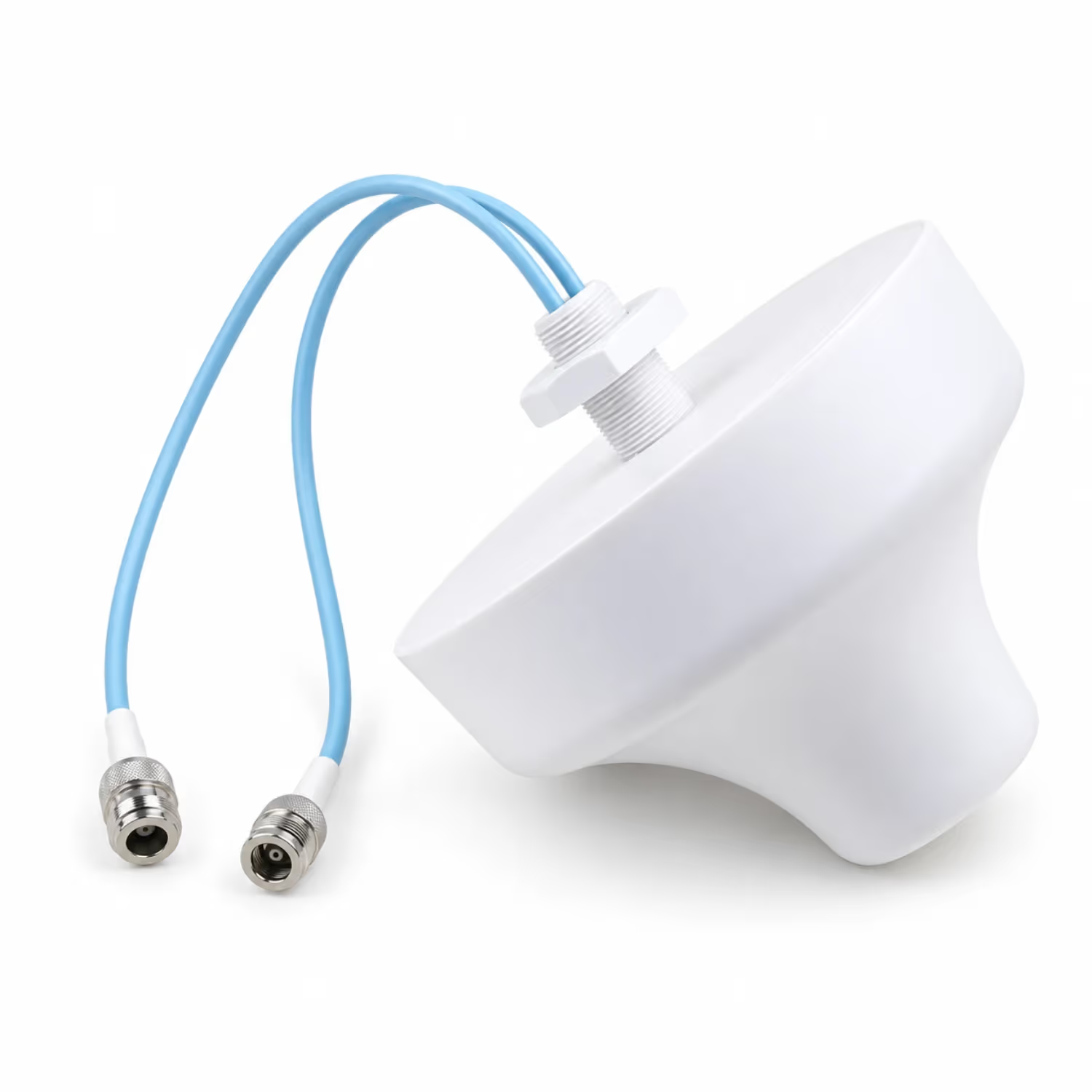
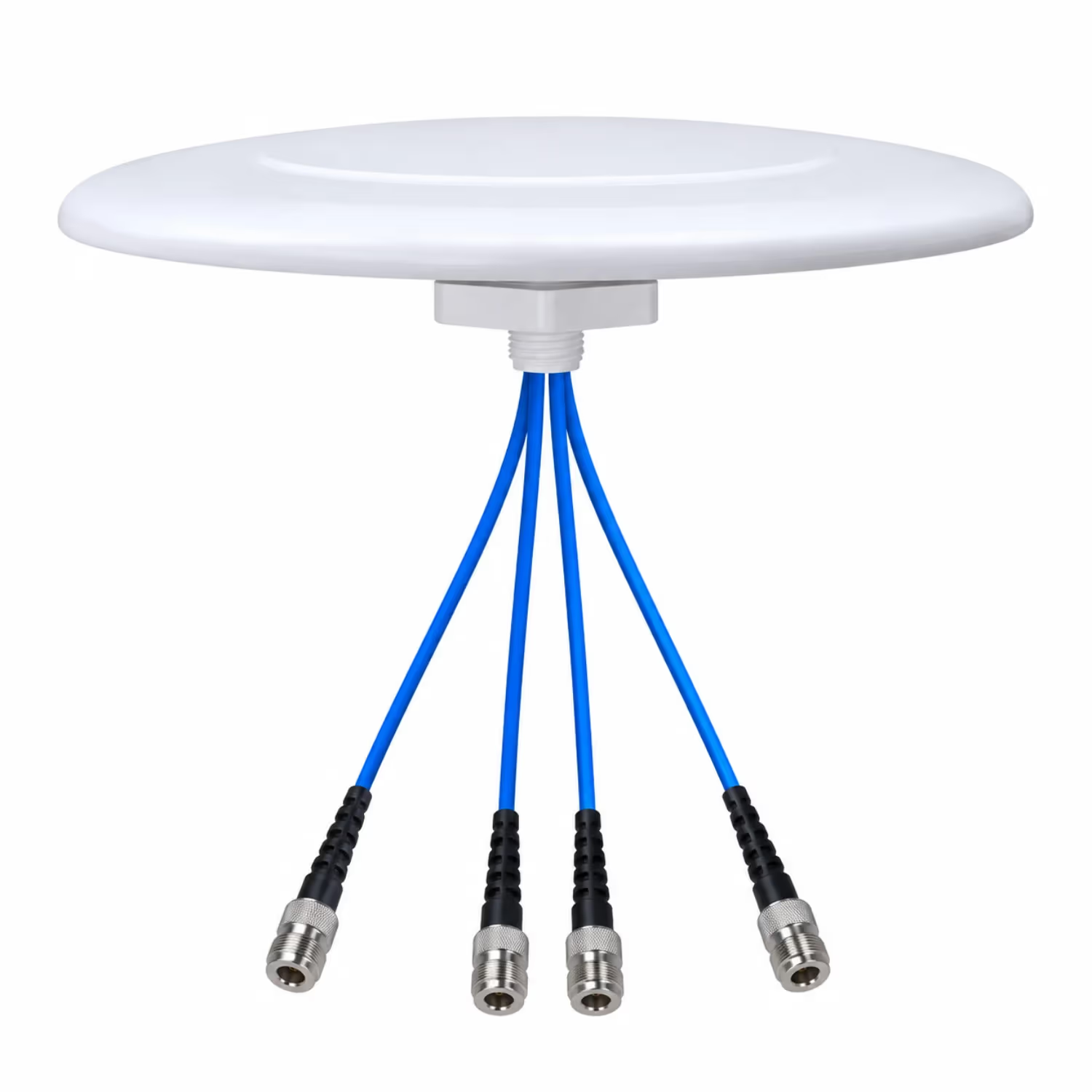
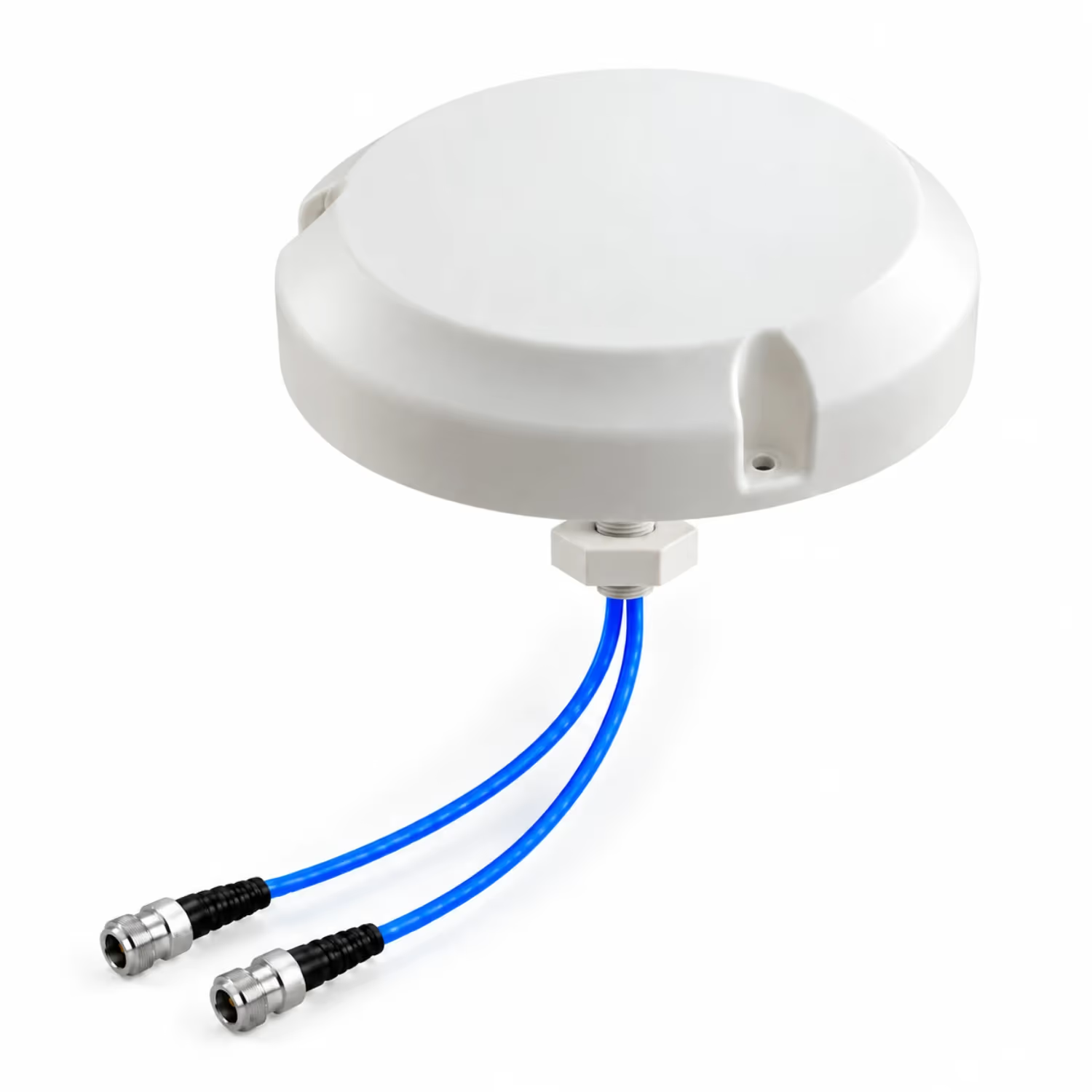
Indoor Omnidirectional Ceiling Antennas
Indoor Panel Antennas
Indoor Wall-Mounted Antennas
Indoor Whip Antennas
Indoor ceiling antennas can be especially suitable for offices, residential properties, hospitality environments, and commercial interiors where broad signal distribution is desired.
Directional indoor panel antennas may be useful when coverage needs to be focused toward a particular room or section of a building.
Final antenna compatibility must be verified according to operating frequency, impedance, connector type, and antenna isolation requirements.
Complete Cellular Signal Booster System ConfigurationA typical signal booster installation follows this connection arrangement:
Outdoor Cellular Tower → Outdoor Donor Antenna → Coaxial Cable → Cellular Signal Booster → Coaxial Cable → Indoor Service Antenna → Compatible Mobile Devices
A potential complete system can include a quad-band cellular repeater, an outdoor log periodic antenna, an indoor ceiling antenna, N-male to N-male coaxial cables, a compatible power adapter, and mounting accessories.
Apex Antennas outdoor LPDA and indoor ceiling antennas can be evaluated as complementary system components.
The exact supplied accessories and complete kit availability depend on the confirmed sales configuration.
Dual LCD Status Displays for Convenient OperationEasy-to-View Operating InformationThe Quad-Band Cellular Signal Booster features two LCD status windows integrated into the front panel.
These displays provide power and output status indications, allowing users to view basic operational information directly on the repeater.
The straightforward front-panel design offers a convenient way to check the unit during normal operation.
Detailed functions such as individual band monitoring, automatic gain adjustment, and advanced fault diagnostics require separate confirmation.
RF Engineering Features for Consistent Signal PerformanceLow Noise FigureThe manufacturer-stated noise figure of ≤4 dB is an important characteristic for cellular signal amplification.
When receiving weak cellular signals, minimizing additional amplifier noise helps preserve the quality of the incoming signal.
This makes noise performance an important consideration for installers designing indoor LTE coverage systems.
Controlled Gain FlatnessThe repeater specifies gain flatness of ≤3 dB.
Gain flatness indicates how consistently amplification is maintained across an applicable frequency range.
Controlled gain variation helps support more uniform RF performance across the operating frequencies.
Low Propagation DelayWith a manufacturer-stated propagation delay of ≤0.5 microseconds, the booster is designed to introduce relatively little additional signal delay.
Low repeater delay is desirable for cellular systems where efficient two-way signal transmission is important.
Standard 50-Ohm RF SystemThe repeater uses a nominal impedance of 50 ohms.
This allows integration with appropriately matched cellular antennas, RF coaxial cables, and related installation components.
The technical specification shows separate outdoor and indoor RF ports, with N-type connectors indicated in the supplied product photographs.
Final connector details should be confirmed before selecting cable assemblies.
Compact Design for Convenient Indoor InstallationSpace-Efficient HousingThe cellular signal repeater features a compact housing suitable for installation in homes, offices, and commercial environments.
Mechanical Specification
Value
Width
20.5 cm
Height
22.8 cm
Thickness
1.7 cm
Weight
1.4 kg
Operating Temperature
-10°C to +60°C
DC Power Input
12 V DC, 3 A
Listed AC Adapter Input
110–220 V AC, 45–55 Hz
Its slim profile makes it suitable for installation in areas with limited available space.
The specified operating temperature range supports use in a variety of suitable indoor environments.
The repeater itself is not specified as weatherproof and should not be assumed suitable for direct outdoor exposure.
Residential Cellular Signal Booster ApplicationsReliable Mobile Communication at HomeWeak cellular reception is a common problem in houses with thick walls, metal roofing, or limited line-of-sight to cellular base stations.
The Quad-Band Cellular Signal Booster helps bring usable outdoor cellular signals into indoor living spaces.
It may improve everyday mobile communication for homeowners who experience unstable reception in bedrooms, living rooms, home offices, or other enclosed areas.
Cellular Coverage for Rural PropertiesRural residents often experience weaker cellular reception because of distance from network towers and surrounding terrain.
A compatible outdoor directional antenna can help receive signals from an available tower, while the repeater distributes amplified LTE signals indoors.
This arrangement may improve indoor calls and mobile connectivity in farmhouses, remote homes, and countryside properties.
Commercial and Business Cellular Coverage ApplicationsOffices and Business WorkspacesReliable mobile communication supports productivity, customer service, and everyday business operations.
The booster can help improve indoor reception for employees and visitors using compatible LTE mobile networks.
Potential applications include small offices, meeting rooms, reception areas, and administrative facilities.
Retail Stores and RestaurantsRetailers, restaurants, and cafés depend on mobile communication for customer interactions, ordering, messaging, and business operations.
Weak cellular reception can create inconvenience for customers and employees.
By improving indoor LTE signal reception, the booster may support more stable mobile communication and compatible cellular-connected payment equipment.
Hotels and Hospitality PropertiesGuesthouses, vacation rental properties, and smaller hotels may benefit from improved mobile coverage in selected indoor areas.
Better cellular reception can support guest communication, mobile internet access, and routine operational activities.
Warehouses and Industrial BuildingsMetal structures and reinforced construction can significantly attenuate cellular signals.
A correctly installed booster system may improve mobile reception in workshops, warehouses, small industrial buildings, and other enclosed facilities.
Cellular IoT and Monitoring ApplicationsCompatible LTE-enabled monitoring equipment, cellular gateways, and smart building devices may benefit from improved indoor reception.
Potential applications include remote monitoring, building automation, and cellular-connected business equipment.
Specific LTE-M, NB-IoT, and device compatibility must be verified separately.
Benefits for Telecommunications Distributors and Professional InstallersFlexible Cellular Coverage SolutionsFor telecommunications distributors and RF system integrators, the Quad-Band Cellular Signal Booster offers a versatile product for addressing common indoor reception requirements.
Support for four LTE frequency bands, external donor and service antennas, and standard 50-ohm RF architecture creates opportunities for configuring systems according to different customer environments.
Professional installers can evaluate directional or omnidirectional outdoor antennas, indoor ceiling antennas, and suitable coaxial cable assemblies to develop installation-specific coverage solutions.
Convenient Antenna and Accessory IntegrationThe repeater can be evaluated alongside complementary Apex Antennas products, helping distributors and integrators identify suitable components for an indoor cellular coverage system.
Potential accessory categories include:
Outdoor Wideband LTE Antennas
Indoor Ceiling-Mounted Antennas
Directional Panel Antennas
50-Ohm RF Coaxial Cables
N-Type RF Connectors
Outdoor Antenna Mounting Accessories
Compatible DC Power Adapters
This approach can simplify RF component sourcing and facilitate the development of application-specific installation packages.
Quad-Band Cellular Signal Booster Technical SpecificationsParameter
Specification
Product Type
Quad-Band Bidirectional Cellular Repeater
Cellular Technology
4G LTE Frequency Band Support
Supported LTE Bands
B2, B4, B5, B28
Band 28 Uplink
703–748 MHz
Band 28 Downlink
758–803 MHz
Band 5 Uplink
824–849 MHz
Band 5 Downlink
869–894 MHz
Band 4 Uplink
1710–1755 MHz
Band 4 Downlink
2110–2155 MHz
Band 2 Uplink
1850–1910 MHz
Band 2 Downlink
1930–1990 MHz
Uplink Gain
≥55 dB
Downlink Gain
≥60 dB
Output Power
18 dBm, conditions not specified
Noise Figure
≤4 dB
Gain Flatness
≤3 dB
Propagation Delay
≤0.5 µs
Impedance
50 Ohms
RF Connections
Outdoor and Indoor Ports
Connector Style
N-Type Shown, Final Configuration to Be Confirmed
Display
Dual LCD Status Windows
Potential Coverage
Up to 300 m²
Dimensions
20.5 × 22.8 × 1.7 cm
Weight
1.4 kg
Operating Temperature
-10°C to +60°C
DC Power Supply
12 V DC, 3 A
AC Adapter Input
110–220 V AC, 45–55 Hz
Installation
Indoor Repeater with External Antenna System
Why Choose the Apex Antennas Quad-Band Cellular Signal Booster?Four LTE Bands in One Convenient SystemThe booster combines support for 700 MHz, 850 MHz, AWS 1700/2100 MHz, and 1900 MHz LTE frequency allocations in a single cellular repeater.
This provides more frequency flexibility than single-band or dual-band alternatives when the intended networks operate within the supported ranges.
Strong RF Amplification SpecificationsWith downlink gain of at least 60 dB and uplink gain of at least 55 dB, the booster is designed to improve usable indoor cellular signal levels.
Its specified noise figure, gain flatness, and propagation delay provide additional RF performance characteristics for technical evaluation.
Adaptable Antenna ConfigurationsCompatibility with appropriately selected donor and service antennas allows installation designs to be adapted to different building layouts and coverage requirements.
Convenient Operating Status DisplayDual LCD windows provide straightforward access to basic operating status information.
Residential and Commercial VersatilityThe system is suitable for evaluation in homes, small offices, rural properties, restaurants, retail stores, and other indoor environments where compatible outdoor LTE signals are available.
Potential Complete System IntegrationApex Antennas provides complementary outdoor and indoor antenna options that can be evaluated for use with the repeater, creating opportunities for integrated cellular coverage solutions.
Installation and Compatibility ConsiderationsFor optimal performance, the outdoor donor antenna should be positioned where a usable cellular signal is available.
The indoor service antenna should be installed to distribute the amplified signal throughout the intended coverage area.
Adequate isolation between outdoor and indoor antennas is essential to reduce feedback, oscillation, and unwanted interference.
Appropriate coaxial cable quality, connector matching, antenna orientation, and cable loss calculations are also important.
The repeater does not generate a cellular network independently and cannot compensate for a complete absence of usable outdoor signal.
Supported LTE bands do not guarantee compatibility with every mobile operator or device.
Regulatory authorization must be confirmed for each intended market. FCC approval and authorization for operation on U.S. cellular networks have not been established for this product.
The product should only be deployed where its use is permitted and any required network operator approvals have been obtained.
Upgrade Your Indoor 4G LTE Connectivity with Apex AntennasWeak cellular reception should not have to limit everyday communication in homes and workplaces.
The Apex Antennas Quad-Band Cellular Signal Booster provides an advanced, flexible solution for improving compatible indoor LTE signals, helping address dropped calls, weak reception, poor building penetration, and inconsistent mobile connectivity.
Combining four supported LTE bands, bidirectional RF amplification, dual LCD displays, and adaptable antenna installation options, this cellular repeater is an excellent candidate for residential signal improvement and small commercial coverage projects.
From rural homes and office buildings to retail shops and industrial workspaces, the system offers a practical way to extend available outdoor cellular coverage into indoor environments.
Explore a more reliable indoor cellular experience with Apex Antennas and discover how the right combination of cellular repeater, outdoor antenna, indoor antenna, and RF accessories can help improve mobile connectivity where it matters most.
Related Products
No related products found.
Related Products (Category & Subcategory)


Related Tags
Related Products (Tags)

5G Omni SISO 4 dBi Antenna
4G LTE5G5G CPE
5G Omni SISO 3 dBi Antenna
4G LTE5G5G NR

5G SISO High Gain 14dBi Panel Antenna
4G LTE5G5G NR

5G LPDA 11 dBi Antenna
11dBi4G LTE5G
5G Wideband Indoor Ceiling Antenna
4G LTE5G NRCDMA
5G MIMO High Gain Ceiling Antenna
4G LTE5G5G NR
5G Indoor Ceiling 4x4 MIMO Antenna
4 Port4G LTE5G
5G Low Profile Ceiling MIMO Antenna
5 GHz Wi-Fi5G5G NR
Reviews
Loading…
4G Quad-Band Signal Booster
Model Number: 4G-4-BAND-BOOSTER
This Quad-Band 4G LTE Cellular Signal Booster helps improve weak indoor cell phone signals, reduce dropped calls, and provide more reliable mobile connectivity in homes, offices, and commercial buildings.
Features
- Quad-Band LTE Coverage
- Improves Indoor Cellular Reception
- Helps Reduce Dropped Calls
- More Stable LTE Connectivity
- Up to 300m² Coverage
- Powerful Bidirectional Signal Amplification
- Dual LCD Status Displays
- Flexible External Antenna Compatibility
- Compact Space-Saving Design
- Low Noise Signal Amplification