Overview
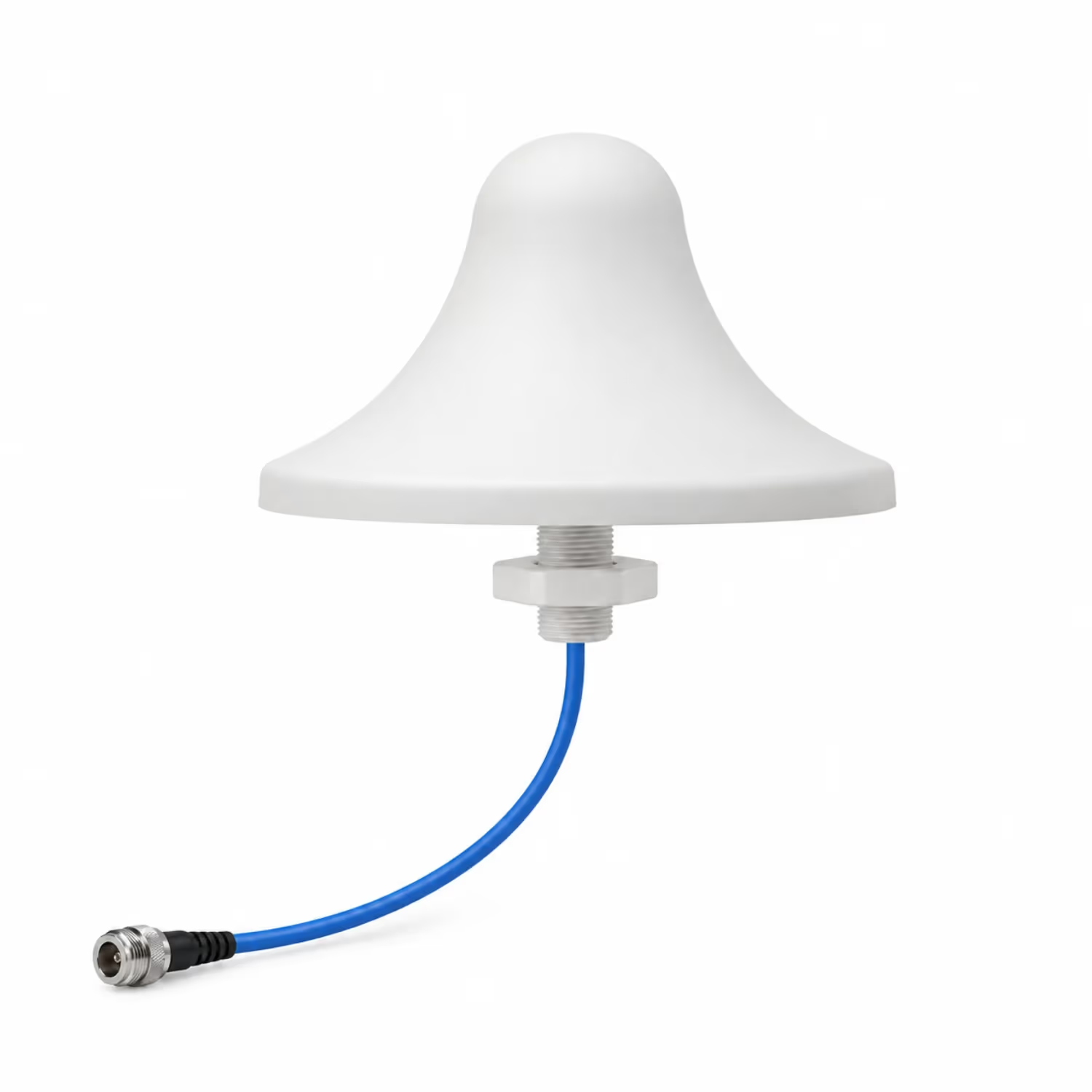
This indoor omnidirectional ceiling antenna helps distribute compatible 4G LTE and 5G cellular signals throughout offices, hotels, retail stores, warehouses, and other indoor spaces. It covers 617–960 MHz, 1710–2700 MHz, and 3400–4000 MHz frequency ranges, with 3 dBi gain and 360° horizontal coverage for broad local signal distribution. The white ABS housing blends neatly into indoor ceilings, while the integrated 40 cm RG141 cable and N-female connector make connection to a compatible signal booster, DAS, private LTE/5G system, or cellular radio simple.
Multiband 4G LTE and 5G Indoor Omnidirectional Ceiling AntennaBring cellular coverage closer to the people and devices that depend on it. This 3 dBi indoor omnidirectional ceiling antenna provides a practical solution for distributing compatible 4G LTE and 5G signals throughout offices, hotels, retail spaces, warehouses, and other indoor environments.
Designed for integration with distributed antenna systems, cellular signal boosters, and compatible radio equipment, it combines multiband frequency coverage with a discreet white ceiling housing. Its 360° horizontal radiation pattern helps distribute signals around each installation point, while the single N-female connection makes integration straightforward for systems using a compatible 50 Ω RF feed.
For building owners, the benefit is a coverage component that fits naturally into the interior. For installers and system integrators, it offers a useful combination of 600 MHz support, conventional cellular frequency coverage, and 3.5 GHz capability in one antenna.
Bring Cellular Service Into Hard-to-Reach Indoor SpacesAddress Weak Reception and Indoor Dead ZonesConcrete walls, building materials, and interior layouts can make outdoor cellular signals difficult to receive indoors. Meeting rooms, guest rooms, basement areas, and spaces deep inside a building may experience weaker reception than areas near windows.
Connected to a properly designed indoor coverage system, this ceiling antenna provides a local point for transmitting and receiving compatible cellular signals. It helps the system serve locations where people need to make calls, access mobile applications, or keep cellular devices connected.
Where weak radio coverage is the cause of poor service, improved indoor signal distribution can help reduce call interruptions and support more consistent cellular data access. Actual results depend on the signal source, system design, building layout, and installation.
Support Everyday Communication and Business DevicesIndoor connectivity serves more than smartphones. Compatible cellular payment terminals, handheld scanners, monitoring gateways, and IoT devices also depend on a usable radio connection.
This indoor cellular antenna can form part of the infrastructure supporting those devices. By placing coverage points where they are needed, businesses can build a system around their operating areas, customer spaces, and equipment locations.
Multiband Coverage for Compatible LTE and 5G NetworksCombine Low-Band and Mid-Band Cellular CoverageThe antenna’s electrical specification lists three operating ranges: 617–960 MHz, 1710–2700 MHz, and 3400–4000 MHz. These separate ranges accommodate numerous cellular bands within one antenna design.
Operating range
Application focus
Customer benefit
617–960 MHz
Compatible 600, 700, 800, and 900 MHz cellular services
Includes low-band coverage that antennas starting at 698 MHz may not provide
1710–2700 MHz
Compatible LTE and 5G services in commonly used cellular spectrum
Supports multiple cellular bands through one antenna feed
3400–4000 MHz*
Compatible 3.5 GHz and selected higher mid-band deployments
Extends application options beyond antennas limited to 2700 MHz
The electrical table specifies 3400–4000 MHz, while the introductory specification text lists 3400–3800 MHz. Confirm the supplied version’s upper frequency limit for applications above 3800 MHz.
Frequency coverage is not continuous between 617 and 4000 MHz. The operating gaps must be considered when selecting the antenna for a particular network.
Include 600 MHz Services in Your Indoor Coverage PlanThe 617 MHz lower frequency limit is valuable for projects requiring compatible 600 MHz cellular service. It provides frequency coverage for LTE B71 and 5G n71, alongside supported higher-frequency services.
For installers replacing an older antenna, this can address a specific limitation of models that begin at 698 MHz or higher. The booster, DAS, cabling, and other RF components must also support the intended frequencies.
Support 3.5 GHz and CBRS ApplicationsThe upper operating range includes 3550–3700 MHz, making the antenna a potential fit for compatible CBRS, private LTE, and private 5G installations.
It also covers portions of 5G n77 and n78. Because both bands begin at 3300 MHz, the antenna should be selected against the actual deployed channels rather than described as covering either entire band. Its specified n78 overlap is 3400–3800 MHz. Coverage above 3800 MHz requires confirmation of the supplied antenna version.
Omnidirectional Coverage for Indoor DistributionReach Multiple Directions From One Coverage PointThe specified 360° horizontal radiation pattern supports signal distribution around the antenna’s mounting position. This makes it useful for indoor spaces where users and devices are spread in multiple directions.
In open offices, reception areas, shops, and communal spaces, an omnidirectional ceiling antenna can provide a practical coverage pattern without aiming a narrow beam toward one side of the room. Walls, metal structures, and other obstructions still influence the resulting coverage.
Balance Local Coverage With 3 dBi GainThe specified 3 dBi gain suits indoor signal distribution where the objective is to serve a local area from an overhead position. The antenna also specifies vertical polarization and an 85° vertical half-power beamwidth, giving system designers additional information for placement and coverage planning.
Antenna quantity and spacing should follow the building’s layout and RF requirements. Large floors, enclosed rooms, and multiple levels may require several planned coverage points.
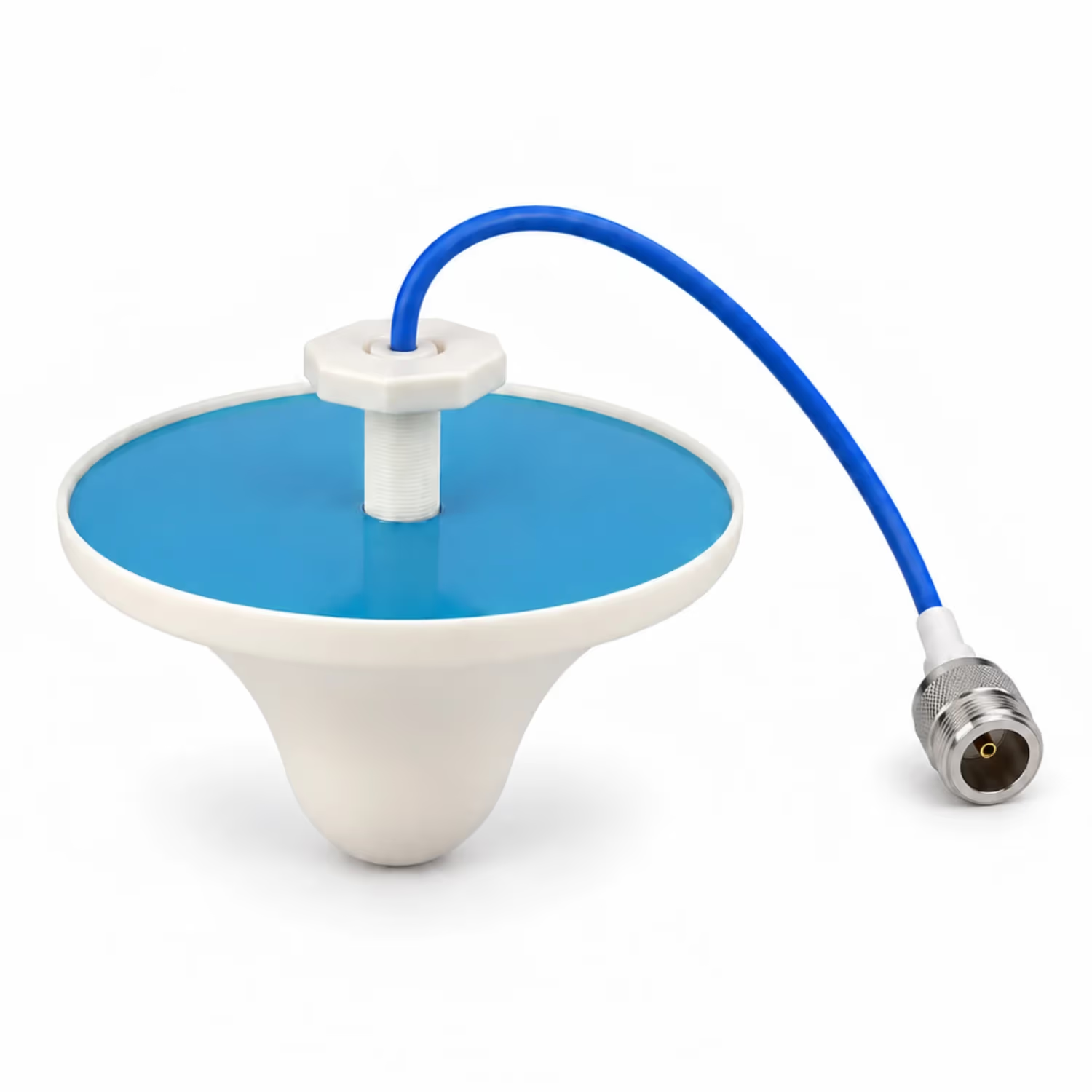
A Discreet Ceiling Antenna for Professional InteriorsMaintain a Clean AppearanceThe white ABS housing fits naturally into many commercial ceilings. Its rounded form provides an unobtrusive alternative to visible desk-mounted or wall-mounted antenna arrangements.
Measuring 185 mm in diameter and 85 mm in height, the antenna gives installers defined dimensions for planning ceiling clearance and appearance. Its specified weight of 0.27 kg also helps with mounting preparation.
For hotels, offices, retail stores, and public-facing facilities, the ceiling location keeps the coverage component away from work surfaces and occupied floor space.
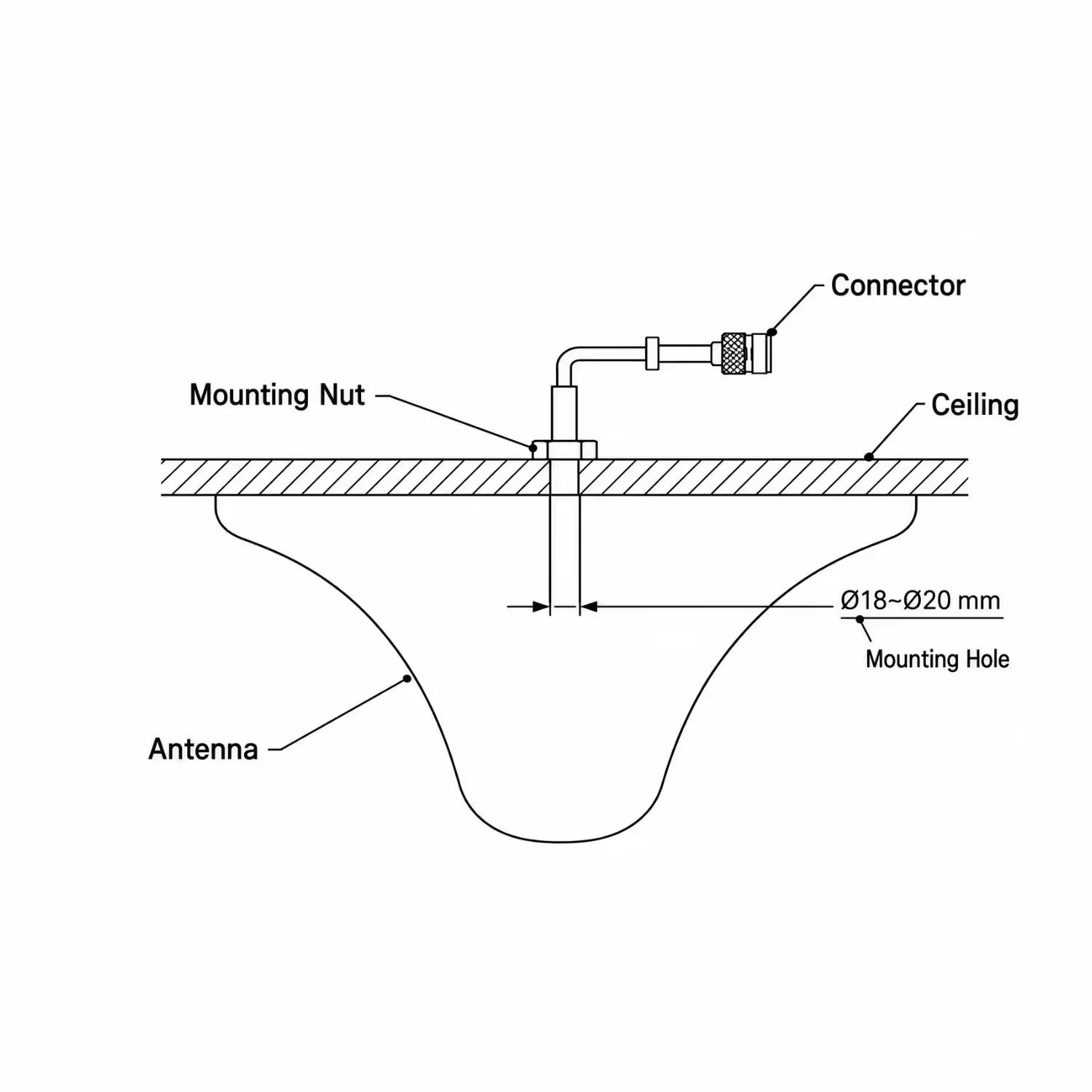
Connect Through an Integrated RG141 CableAn attached 40 cm RG141 coaxial cable provides a short lead between the antenna and the feeder connection. This offers flexibility when positioning the connection near or above the ceiling.
The cable terminates in an N-female connector with external threads and a female center contact. It mates with a compatible N-male connector. The antenna’s 50 Ω impedance suits compatible cellular RF infrastructure.
Longer feeder runs require separately selected coaxial cable. Cable attenuation, especially at higher frequencies, should be included in the system’s signal budget.
Integration With Indoor Cellular InfrastructureDistributed Antenna SystemsUse the antenna as an indoor coverage point within a compatible distributed antenna system. Multiple antennas can be positioned across a building and connected through a planned network of feeder cables, splitters, and couplers.
This makes it relevant to DAS integrators and telecom contractors working on office buildings, hospitality properties, retail developments, and institutional facilities. Projects with specified passive intermodulation requirements need separate PIM verification, since the supplied specification does not include a PIM rating.
Cellular Signal Boosters and RepeatersThe antenna can serve as the indoor service antenna for a compatible cellular signal booster or repeater. It distributes the supplied RF signal into the intended indoor area and receives signals from compatible devices.
It is a passive antenna. The connected booster or radio system provides the active functionality, and the complete installation determines the coverage result.
Private LTE, Private 5G, and External-Antenna Small CellsFor enterprise networks, the antenna offers a ceiling-mounted option when the radio supports external antennas and operates within the specified ranges.
Potential applications include indoor private cellular networks in warehouses, factories, campuses, and commercial buildings. Radio compatibility, connector type, power, polarization, and antenna configuration should be checked during system design.
Applications Across Commercial and Enterprise EnvironmentsEnvironment
Typical application
Value to the customer
Offices and coworking spaces
Coverage in work areas, meeting rooms, and reception zones
Supports mobile communication throughout designated indoor spaces
Hotels and serviced apartments
Coverage in guest areas, corridors, and lobbies
Helps provide convenient cellular access for guests and staff
Retail stores and shopping centers
Coverage for shops, checkout areas, and shared spaces
Supports customer access and compatible cellular business devices
Restaurants and entertainment venues
Indoor mobile coverage and cellular terminal connectivity
Helps serve communication needs in customer-facing spaces
Healthcare facilities
Cellular coverage in approved staff and visitor areas
Supports facility connectivity objectives
Schools and universities
Coverage in classrooms, libraries, and administrative areas
Supports indoor cellular access across selected campus buildings
Warehouses and logistics facilities
Coverage for compatible scanners, terminals, and gateways
Helps connect devices in planned operational zones
Industrial buildings
Private or public cellular signal distribution
Supports compatible workforce and equipment connectivity
Airports and railway terminals
Coverage in passenger areas and offices
Adds indoor coverage points within a larger system
Convention and exhibition venues
Permanent or temporary cellular distribution
Supports coverage planning across event spaces
Basements and parking areas
Distribution of a remotely supplied cellular signal
Brings service into locations with limited direct outdoor reception
Residential common areas
Coverage connected to a suitable building or booster system
Helps address weak reception in shared indoor spaces
Smart buildings
Coverage for compatible cellular IoT devices
Supports meters, sensors, monitoring gateways, and connected terminals
Practical Benefits for Installers and Equipment BuyersSimplify Antenna Selection Across Supported ProjectsA multiband antenna can reduce the need to source separate models for each supported frequency range. Where system requirements match, the same antenna design can be used across multiple indoor coverage projects.
This is useful for RF distributors, telecom equipment suppliers, signal booster installers, and system integrators managing repeat installations or replacement stock.
Keep the RF Connection StraightforwardThe single-port configuration provides one RF feed for a compatible system branch. It is well suited to applications requiring a single vertically polarized indoor antenna.
For projects requiring 2×2 or 4×4 MIMO, the network must use an appropriate arrangement of independent antenna paths. One unit does not provide integrated multiport MIMO functionality.
Plan With Defined Electrical SpecificationsThe specified VSWR of ≤1.8 provides an impedance-matching criterion for antenna selection. The 50 W maximum input power gives designers a stated limit to check against the power reaching each antenna.
These values help buyers assess compatibility alongside frequency coverage, feeder losses, connector requirements, and installation conditions.
Technical SpecificationsParameter
Specification
Antenna type
Indoor omnidirectional ceiling antenna
Frequency ranges
617–960 MHz, 1710–2700 MHz, 3400–4000 MHz*
Gain
3 dBi
Horizontal coverage
360°
Vertical half-power beamwidth
85°
Polarization
Vertical
VSWR
≤1.8
Input impedance
50 Ω
Maximum input power
50 W
RF connections
One
Connector
N-female
Integrated cable
RG141
Cable length
40 cm
Housing material
ABS
Color
White
Dimensions
185 mm diameter × 85 mm height
Weight
0.27 kg
Operating temperature
−40°C to +65°C
DC grounding
Specified as DC grounded
Confirm the upper operating limit before selecting this antenna for frequencies above 3800 MHz.
Select the Right Antenna for Your InstallationFor a successful installation, match the antenna to the complete RF system:
Confirm that all required uplink and downlink channels fall within the specified operating ranges.
Check the radio, booster, or DAS antenna-port requirements.
Verify the N-type connection, 50 Ω impedance, and expected input power.
Account for feeder cable losses, splitters, and couplers.
Plan antenna locations around the building layout and intended coverage areas.
Confirm any project-specific PIM, environmental, or approval requirements.
This multiband indoor ceiling antenna brings together 600 MHz support, conventional cellular coverage, 3.5 GHz capability, and a discreet omnidirectional design. For compatible indoor cellular systems, it provides a practical connection point between your network infrastructure and the people and devices it serves.
Related Products
No related products found.
Related Products (Category & Subcategory)

Related Tags
Click on a tag to see related products
Related Products (Tags)

5G Omni SISO 7 dBi Antenna
5G5G NRCPE

5G Omni SISO 4 dBi Antenna
4G LTE5G5G CPE
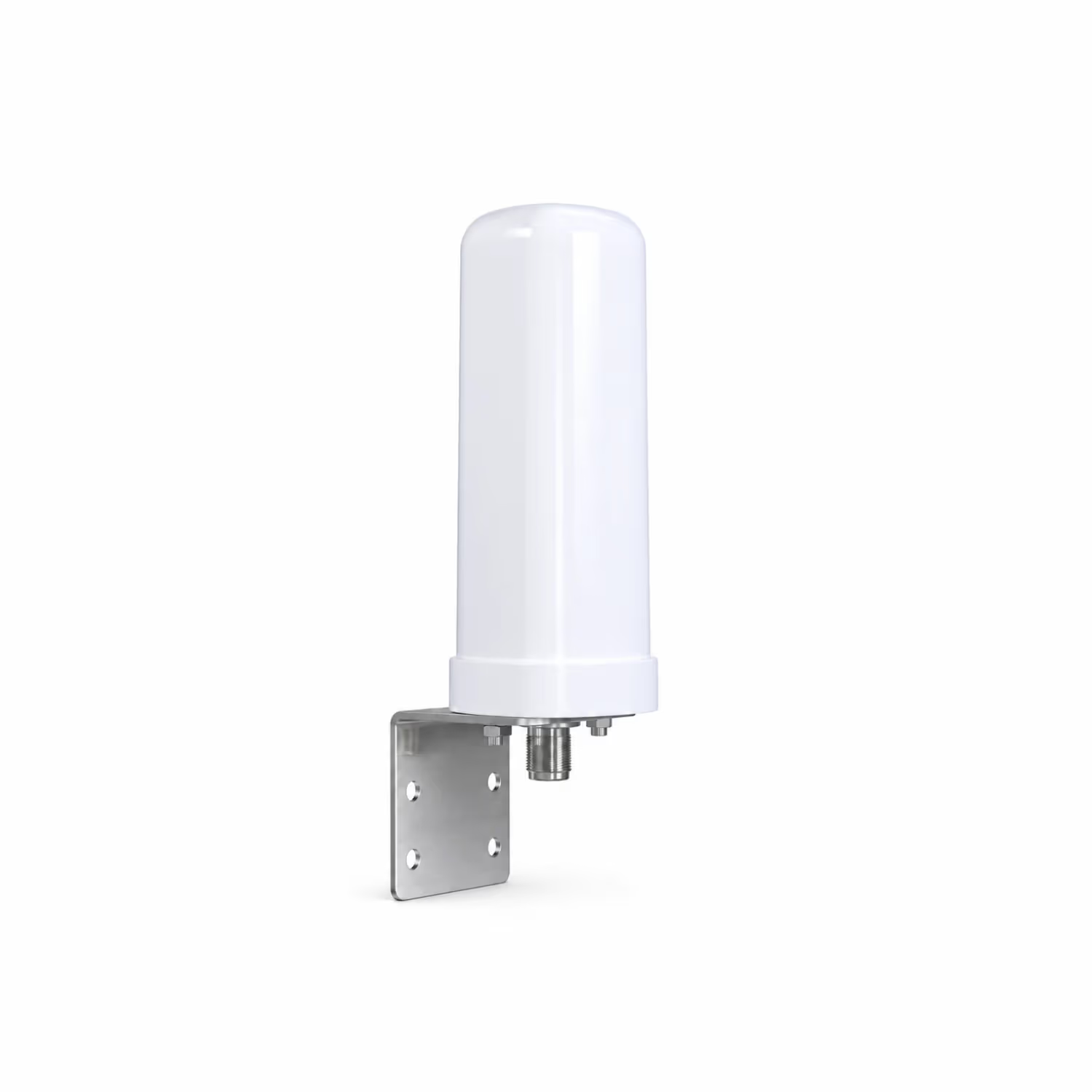
5G Omni SISO 3 dBi Antenna
4G LTE5G5G NR

5G MIMO High Gain Panel Antenna
2 portD2DFWA
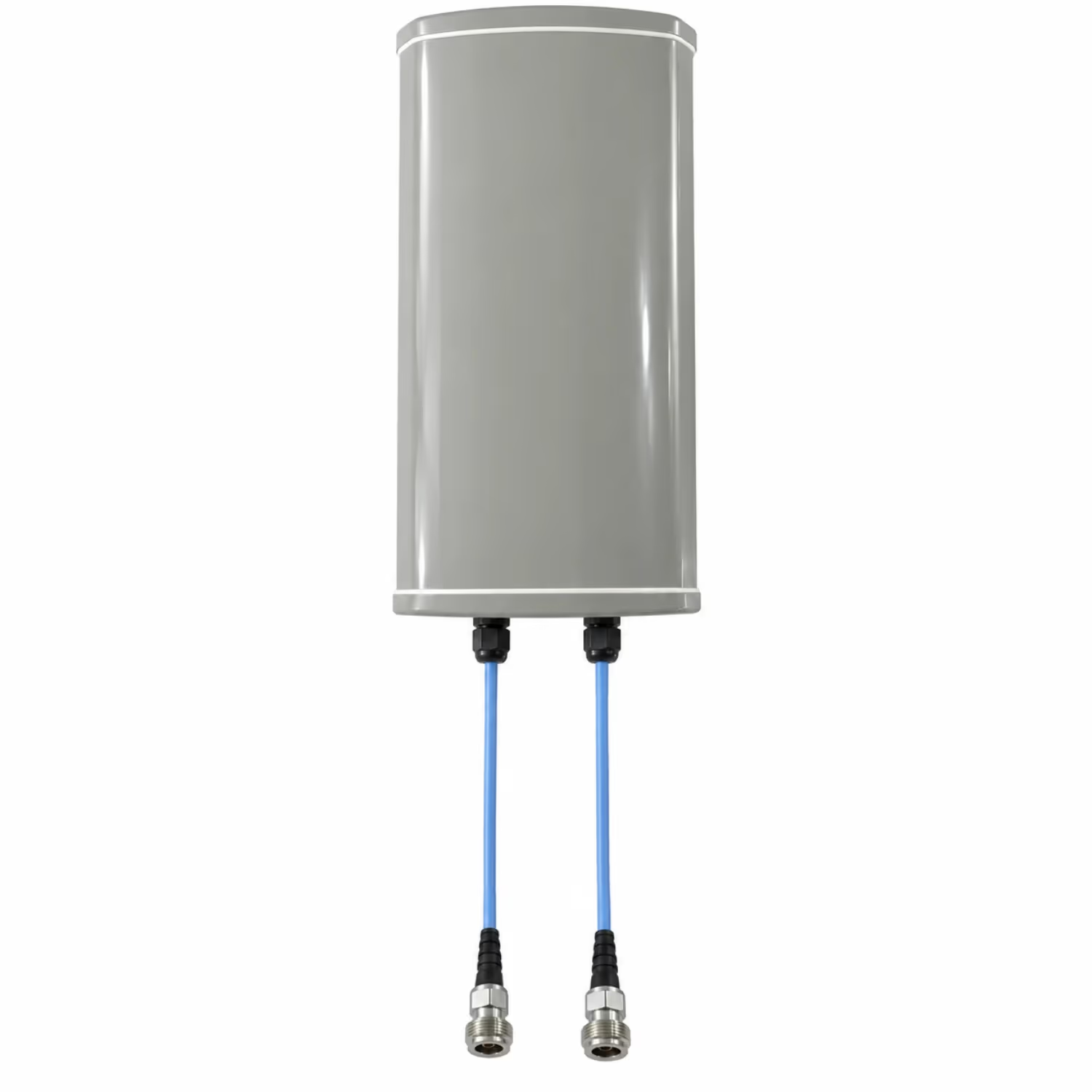
5G MIMO 9 dBi Panel Antenna
2 port5G5G CPE

5G SISO High Gain 14dBi Panel Antenna
4G LTE5G5G NR
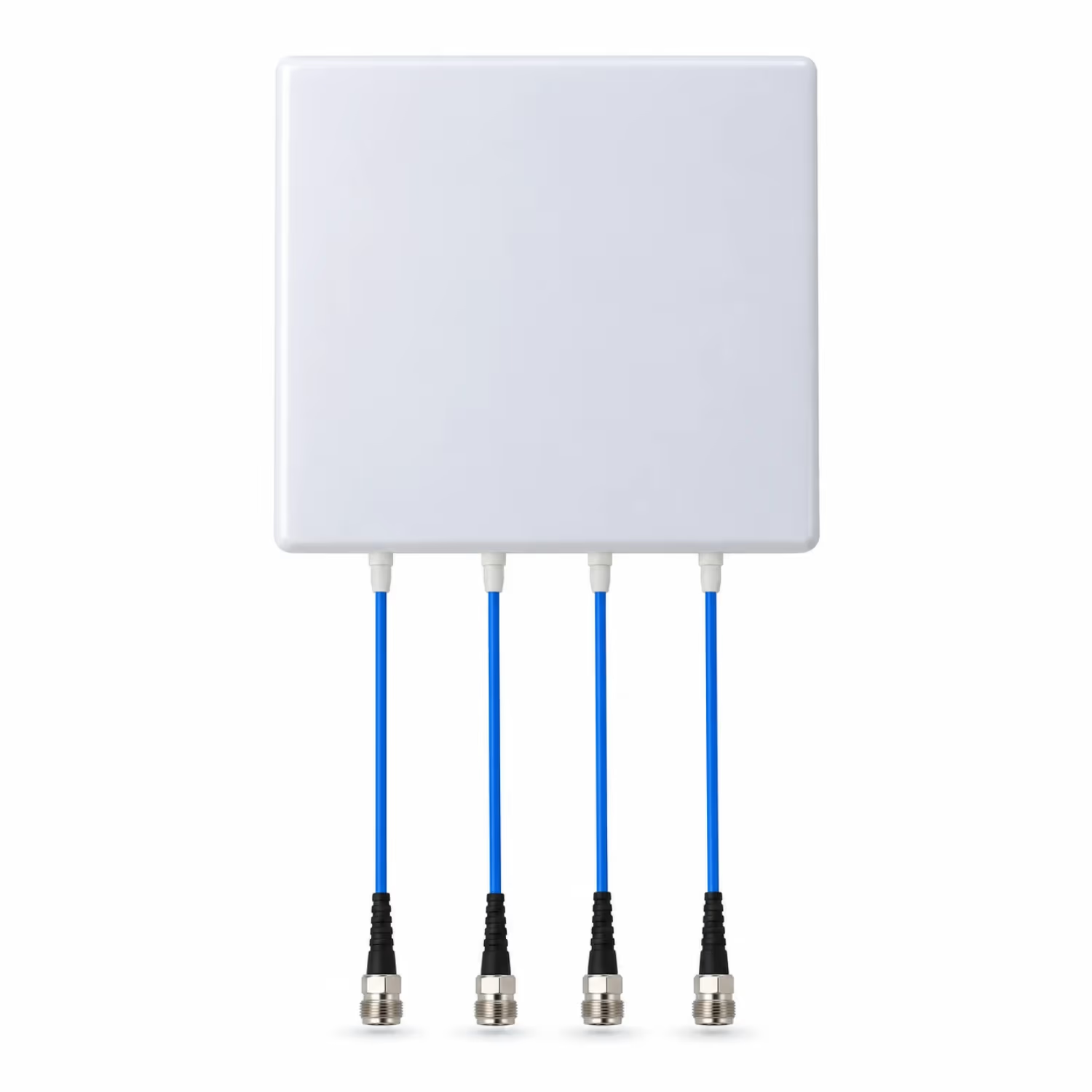
5G MIMO 4x4 9 dBi Panel Antenna
4 Port5G5G NR

5G LPDA 11 dBi Antenna
11dBi4G LTE5G
Reviews
Loading…
5G SISO Indoor Ceiling Antenna
Model Number: 5G-SISI-CEILING
This discreet ceiling antenna helps distribute 4G and 5G signals indoors when connected to a compatible signal booster or cellular coverage system.
Features
- Supports multiple LTE/5G bands
- 360° horizontal signal coverage
- Supports 600 MHz cellular services
- Supports 3.5 GHz networks
- Discreet white ceiling design
- Space-saving overhead installation
- Convenient N-female cable connection
- Includes 40 cm RG141 cable
- Lightweight for easier handling
- No separate power supply needed